
Welcome to the Chancellery Repository
The Chancellery Repository serves as the private archival and administrative office of the Princely House of Sharif-Giedroyć. It exists for the preservation, cataloguing, and transmission of genealogical records, family correspondence, heraldic material, and historical documentation relating to this cadet branch.
The Repository is maintained as a private family institution dedicated to historical preservation and intergenerational continuity of documented heritage.
While its primary function is archival, the Repository also serves as a point of reference for family members, historians, and researchers engaged with the historical and genealogical study of the lineage preserved within its records.
Scope of Public Summary and Access to Archival Holdings
A brief overview of the historical framework and documentary scope of the Repository is provided below for general reference. This summary is not exhaustive and does not represent the full extent of the archival materials held within the private collection.
The digitised archival holdings and extended genealogical records are maintained within a restricted members-only section of the Repository. Access is limited to verified lineal descendants and authorised correspondents of the Chancellery.
For access inquiries or correspondence regarding the archival materials, please contact the Chancellery directly. Requests for access are reviewed on a case-by-case basis in accordance with the internal archival protocols of the House.
Historical Foundation
The history of this family is rooted in the Baltic princely (Kniaz) tradition. According to the documented genealogy preserved within the House archives, the lineage descends from Prince Dausprungas, brother of King Mindaugas, through Prince Giedrius, the 13th-century ruler and founder of Giedraičiai, from whom the historic Giedroyć family traces its origin.
The title held by our ancestors is a historical Kniaz designation. The House maintains that its princely dignity derives from hereditary dynastic descent rather than from the creation of a title by any later sovereign authority. Accordingly, the House regards the confirmations of princely status issued by later sovereign authorities as recognitions of an already existing hereditary dignity rather than constitutive creations of that dignity.
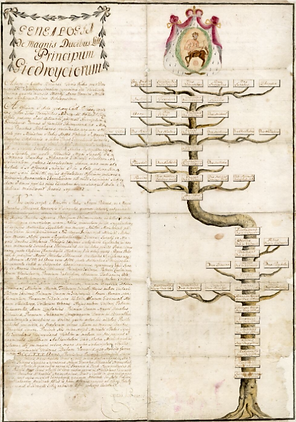
1811 Confirmation of Princely Status - First page of 11. A Full copy held in Archives. Genealogical chart (Kunigaikščių Giedraičių genealoginis medis, c. 1780).
Within the historical and juridical tradition maintained by this House, the dynastic rights associated with that hereditary dignity are understood to arise from primordial bloodright and are preserved as part of the historical identity of the lineage, independent of any contemporary claim to political sovereignty or governmental authority.
On the Historical Formation of Cadet Branches
The Chancellery notes that within the legal and familial traditions of the historic Grand Duchy of Lithuania and the broader Polish-Lithuanian Commonwealth, the formation of a cadet branch (linia or gałąź) did not operate under the state-licensed frameworks of Western European feudal law. Instead, a cadet branch emerged naturally and autonomously through generational descent, territorial migration, and the establishment of distinct familial lines from the parent house (Ród).
In accordance with these regional precedents, the status of this branch as a legitimate continuation of the lineage rests solely upon documented genealogical descent from our ancestral house.
Historical Genesis & Lineal Migration
The Baltic Core & The Primordial Right
The village of Giedraičiai in modern times Prince Traidenis Grand Duke of Lithuania, brother of Prince Giedrius
The origins of the lineage are fundamentally tied to the early consolidation of the Grand Duchy of Lithuania. Because the family's historic princely status was held by virtue of independent ancestral sovereignty prior to the formation of centralized kingdoms—subsequent recognitions within the Polish-Lithuanian Commonwealth and the 19th-century decrees of the Russian Directing Senate were purely declaratory acts, acknowledging an immutable, pre-existing historical reality.
The Lipka Tatar Synthesis & Military Heritage
In the late 14th and early 15th centuries, Grand Duke Vytautas settled communities of Muslim Tatars from the Golden Horde within the borders of the Grand Duchy of Lithuania, granting them noble status (Szlachta) and land in exchange for elite military service. This gave rise to the Lipka Tatars—a unique cultural and martial community that maintained its Islamic faith while fiercely defending the crowns of Lithuania and Poland for generations.
The synthesis of this line represents a profound convergence where these two distinct historical streams met. The integration of Sharifian descent within the Lipka Tatar noble tradition introduces a sacred lineage into the martial framework of the Baltic core. This historical migration from the steppes to the borderlands of Europe created a unique dual identity, which this Chancellery is specifically mandated to document and preserve.
Lineal Heraldry & Armorial Traditions
From Kunigaikščių Giedraičių genealoginis medis, c. 1780. From an 1800 Confirmation of Princely Status
The armorial achievement displayed throughout this Repository constitutes the officially adopted heraldic achievement of the Princely House of Sharif-Giedroyć and has been marshalled under the authority of the Head of the House for this cadet branch, in accordance with the historical customs, ancestral compacts, and internal traditions of this House.
The design represents the historical identity and ancestral composition of this cadet branch. In accordance with the historical customs of the Lipka Tatar nobility and the Polish-Lithuanian tradition of armorial variations (odmiany), the design intentionally departs from the traditional Giedroyć hippocentaur and instead embraces the older, ancestral symbol of the heraldic rose, a choice that simultaneously respects the aniconic customs associated with the House's Lipka Tatar Muslim heritage. Each element of the shield commemorates a distinct ancestral stream preserved within the lineage:
-
Quarters I and IV (The Five Arrows and White Rose): Representing an armorial adaptation of the historic Giedroyć archer motif. The arrows honour the five principal ancestral figures through whom this cadet branch has been transmitted, while the white rose recalls an early emblem traditionally associated with the primordial Giedroyć family.
-
Quarter II (The Oak): Commemorating multiple ancestral noble lines and symbolising strength, endurance, and rooted inheritance.
-
Quarter III (The Pillars of Gediminas): Adopted by the House as a symbolic representation of the documented Gediminid ancestry preserved within the lineage.
-
The Inescutcheon: At the center, the crescent and star upon a green field represent the Sharifian and Lipka Tatar heritage, acting as the spiritual and historical core that binds these two distinct ancestral streams together under a single shield.
-
The Princely Pavilion & Dual Crowns: Employed as heraldic symbols adopted by the House. Within the heraldic tradition of this cadet branch, the external crown represents the historic dynastic dignity inherited through the family's primordial princely origin, while the internal crown signifies the active, autonomous administration of this House by virtue of its traditional familial autonomy and domestic governance.
Historical & Jurisprudential Context
The Chancellery recognises an important historical distinction between municipal systems of nobiliary law—where titles and dignities arise through the legislative authority of a sovereign state or reigning fountain of honour—and the dynastic traditions of certain ancient princely lineages whose origins predate the formation of those later legal systems.
The Princely House of Sharif-Giedroyć understands its own historical continuity within the latter tradition. Accordingly, the internal administration, genealogical succession, heraldic practice, and familial governance of this House are maintained in accordance with its historical customs, traditional family compacts, and regional legal precedents, while fully recognising the exclusive civil jurisdiction of contemporary states in all matters of public law.
Autonomous Governance.
The House maintains that the historic traditions of the primordial Baltic princely families and the Lipka Tatar nobility afforded considerable autonomy in the internal governance of individual lineages and cadet branches. The administrative functions exercised by this Chancellery are understood as the continuation of those historical familial customs and are confined exclusively to the internal affairs of the House.
Lineal Continuity & Regional Custom
The House further maintains that the preservation of dynastic continuity has historically depended not only upon legal succession but also upon documented genealogy, familial compacts, and the continuous transmission of identity, heritage, and historical memory. The genealogical principles observed by this cadet branch are therefore derived from the documentary traditions preserved within the House archives and interpreted in accordance with its historical understanding of lineal continuity unique to the Polish-Lithuanian and Lipka Tatar nobility.
Heraldic Authority
The heraldic achievement adopted by the House reflects the documented ancestry, cultural inheritance, and historical identity of this cadet branch. In accordance with the heraldic traditions recognised by the House, adaptations to the armorial achievement may be made where necessary to reflect the historical development of the lineage, including the incorporation of the House's Lipka Tatar and Sharifian heritage, while preserving continuity with its ancestral origins.
Mandate & Scope of Operations
The Chancellery functions exclusively as the private administrative office, genealogical registry, and archival repository of the Princely House of Sharif-Giedroyć. Its mandate is confined to the following operations:
-
Archival Conservation: The collection, indexing, and translation of vital family records, dynastic compacts, and historical correspondence on museum-grade, acid-free media.
-
Cultural Preservation: Documenting the historical migration, identity, and legacy of the Lipka Tatar noble lines within the Grand Duchy of Lithuania and the Polish-Lithuanian Commonwealth.
-
Genealogical Research: Providing a secure, centralized registry for verified lineal descendants to access family records and historical primary source materials, while maintaining scholarly correspondence with academic historians and archival institutions.
Notice of Autonomy & Fraternal Relations
The Princely House of Sharif-Giedroyć constitutes an autonomous cadet branch of the historic primordial princely Giedroyć lineage. The House governs its own internal affairs according to its House Law and exercises no authority beyond the membership of this cadet branch.
This branch remains self-contained, representing exclusively the specific lineal line transmitted through Prince Wladislaw Giedroyć. The Chancellery asserts no ancestral authority over, nor does it seek to politically or legally bind, any collateral lines descending from Prince Wladislaw, any other collateral branches, or individuals holding the broader Giedroyć surname globally, nor does it diminish the equal historical dignity of those branches.
Prince W Giedroyc & Princess M Giedroyc c. 1900
While operating independently, the Chancellery maintains a deep reverence for our shared origins. We warmly welcome communication from our extended Giedroyć cousins across all branches. Because we share the same historic roots, our Archives preserve extensive genealogical documentation, historical records, and ancestral data that may be of profound interest to the wider family. Furthermore, we extend an open invitation to any collateral lines wishing to ensure the permanent preservation of their own branches' vital records, historical correspondence, or armorial history. The Chancellery stands ready to accept these administrative deposits into our repositories, safeguarding them alongside the core collection for future generations



.jpg)
One of many Lipka Tatar arms featuring a tamga. It is called Kiena and was used by multiple families. More such Lipka Tatar arms can be found in the book “Herbarz rodzin tatarskich w Polsce” by Stanisław Dziadulewicz
Kaunus Mosque, Lithuania. First built in 15th century. Rebuilt in 1933
19th century depiction of a Tatar family


